
How Can AI Automate Business Processes?
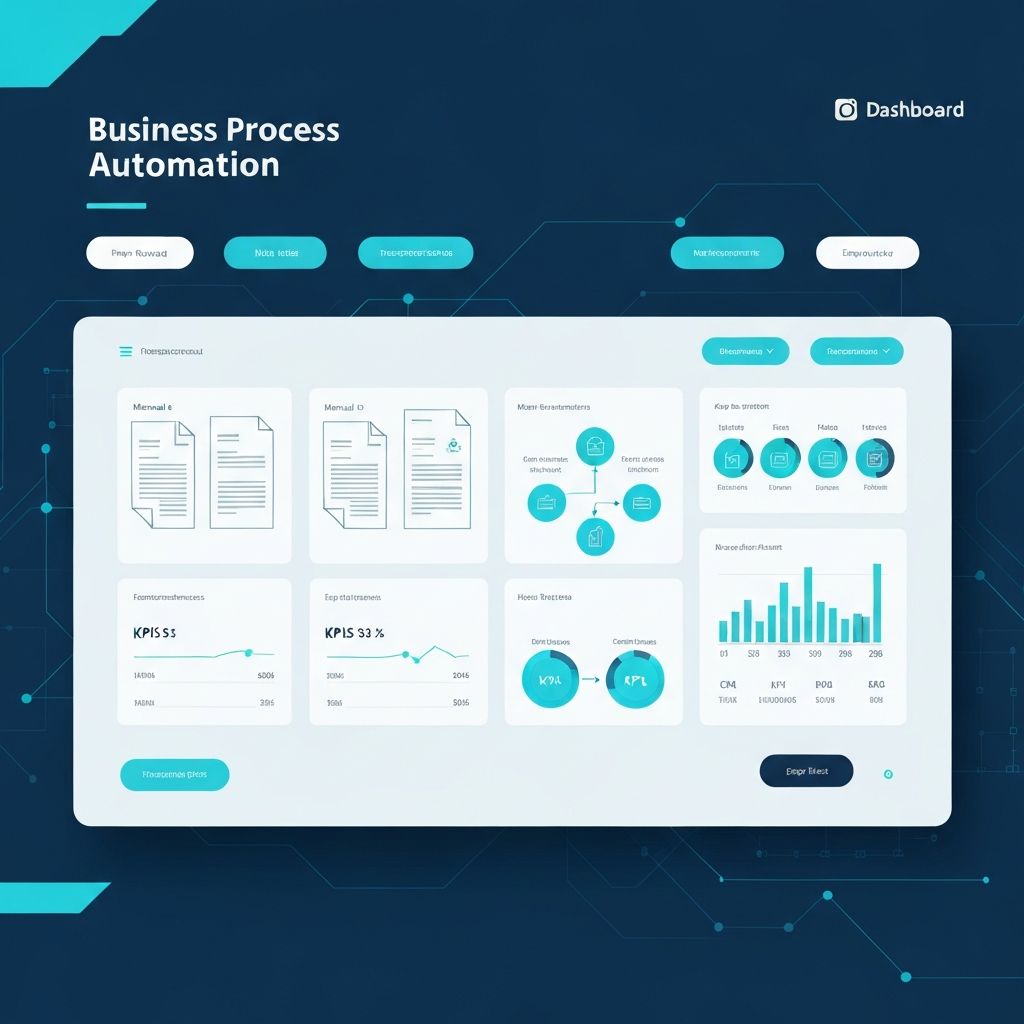
Structured methodology transforms manual workflows into intelligent systems, delivering 30-200% first-year ROI
Most automation projects fail not from technology limitations but from poor methodology. Industry data shows 30-50% of automations fail globally, yet companies implementing structured approaches report 30-200% ROI within the first year. The difference lies in systematic process: identifying appropriate workflows, designing intelligent solutions, integrating with existing systems, and continuously optimizing. The business process automation market growing from $13 billion in 2024 to $23.9 billion by 2029 reflects organizations discovering what works.
Successful automation requires more than technology—it demands process transformation. McKinsey research emphasizes workflow redesign delivers the biggest effect on bottom-line impact from AI, with 21% of organizations having fundamentally redesigned workflows reporting significantly higher returns. The automation itself proves straightforward; the challenge lies in choosing right processes and implementing properly.
The Six-Stage Implementation Framework
Stage 1: Assessment and Planning
Assessment and planning spans 1-2 weeks identifying automation candidates. Effective selection requires specific criteria: high business impact, rules-based with clear inputs and outputs, repetitive and time-consuming, minimal human judgment required, and benefits for both employees and customers. Teams quantify potential benefits through ROI estimation, calculating expected cost savings against implementation costs. A manufacturing company reduced invoice processing turnaround by 67% while cutting human effort by 83%, achieving 100% accuracy—but only after careful candidate selection during assessment.
Stage 2: Process Analysis and Mapping
Process analysis and mapping takes 1-3 weeks documenting existing workflows and identifying pain points. Visual modeling using BPMN (Business Process Model Notation) or flowcharts maps every step, decision point, and dependency. This reveals bottlenecks invisible in day-to-day operations. One banking institution discovered their letter of credit processing involved 47 distinct manual steps across six systems—understanding that complexity enabled them to automate the end-to-end flow, saving 890+ man-hours monthly while reducing human dependency by 80%.
Stage 3: Design
Design requires 2-3 weeks creating detailed automation blueprints. This defines business rules, triggers, notifications, integration points with existing systems, and exception handling. The design phase determines success—rushed designs create brittle automations requiring constant maintenance. Comprehensive designs anticipate edge cases and variations. A healthcare provider automated claims processing across 40+ insurers by designing flexible rules that adapted to varying submission requirements, saving 37,000 hours annually while reducing the claim-to-cash period by 9 days.
Stage 4: Development
Development timeline varies by complexity: 3-4 weeks for straightforward processes, 6-7 weeks for medium complexity, 10-12+ weeks for high complexity involving multiple systems. Development configures automation platforms, builds custom scripts, integrates with CRM/ERP/legacy systems, and documents technical specifications. Low-complexity projects involve few business rules and minimal applications—like basic data entry. Medium complexity includes multiple applications with enhanced fail-safes—invoice processing, approval workflows. High complexity spans numerous business rules, critical tasks with compliance impacts, and customer experience considerations.
Stage 5: Testing
Testing demands 2+ weeks for comprehensive validation. Pilot testing in controlled environments precedes user acceptance testing (UAT) with stakeholders. Various scenarios and edge cases undergo simulation. Iteration based on feedback prevents production issues. A major cloud provider implementing test automation achieved 96% reduction in error rates through rigorous testing, establishing 100% code review coverage before production deployment.
Stage 6: Deployment and Monitoring
Deployment and monitoring begins with phased rollout starting from pilot projects. Comprehensive employee training ensures adoption. Performance monitoring through analytics dashboards tracks KPIs and enables continuous improvement. Most implementations achieve value within 4-12 weeks total for standard projects.
Transformation Examples Showing Before and After
Invoice Processing Revolution
Manual invoice processing previously required 4+ FTEs manually transcribing hundreds of vendor invoices monthly into SAP, causing significant delays. Automated intelligent document processing deployed within 10 days delivered 67% reduction in turnaround time, 83% reduction in human effort, 100% accuracy, and complete same-day processing. Annual savings exceeded $90,000 from invoice automation alone.
Payment Processing at Scale
Payment processing transformation illustrates scale potential. Fifty call center agents made 2,000 daily IVR calls for insurance payments—100,000 calls monthly consuming 500+ man-hours. End-to-end automation via intelligent platform saved 500+ monthly man-hours, improved turnaround time 30%+, increased daily payment processing 220% (from 500 to 1,600), and maintained zero downtime. The economic impact: eliminating need for scaling headcount linearly with volume.
Medical Coding Excellence
Medical coding and billing involved 70,000+ codes across categories—tedious, error-prone manual work. AI-powered RPA bots with ML capabilities for chart analysis delivered 95% reduction in manual work, 90% improvement in coding accuracy, and 85% faster processing turnaround. Healthcare organizations redirected skilled staff from manual coding to higher-value patient care activities.
Collections Transformation
Collections automation at a major telecommunications company implemented 102 automations over 2 years. Results: 108x increase in collections efficiency, $635,000 monthly savings, and overdue notifications scaled from 200 letters monthly to 17,722 emails plus 3,811 letters—all processed automatically. The scaling demonstrates automation's fundamental advantage: handling exponentially more volume without proportional cost increases.
Common Bottlenecks Businesses Automate
Manual and repetitive tasks constitute the highest-value targets: data entry, document processing, invoice approval, payment posting, reconciliation, and report generation. Distribution of bottlenecks by department shows Marketing at 22%, Project Management at 22%, Operations at 19.4%, and Sales at 16.7%. These departments capture immediate value from automation.
Approval Delays
Approval delays plague most organizations. Multi-level approval workflows, document sign-offs, purchase orders, and compliance approvals slow operations. Automating approval routing based on predefined rules with automatic escalation eliminates delays. One aerospace company saved £52 million by automating vendor payment processes, eliminating late fees through timely automated approvals.
System Integration Issues
System integration issues create data silos. Legacy system limitations, disconnected tools, and manual data transfers between applications waste time while introducing errors. Modern automation platforms integrate via APIs, enabling seamless data flow. A manufacturing company automated 20+ processes across unintegrated systems, reducing total operating costs by 40% through eliminating manual data transfers.
Intelligent Lead Routing
Lead routing exemplifies intelligent automation replacing manual bottlenecks. Traditional approaches: leads arrive via forms, someone manually reviews and assigns based on geography or availability, delays occur, hot leads cool, conversion rates suffer. Intelligent routing with predictive scoring automatically captures leads, scores them using ML models analyzing behavior and firmographic data, routes instantly to appropriate sales rep based on region/expertise/capacity, and triggers personalized follow-up sequences. Financial services firms implementing this report 346% more inbound leads and 98% more closed deals within 12 months.
Technologies Powering Automation
Robotic Process Automation (RPA)
Robotic Process Automation (RPA) represents 31% of BPA technology adoption in 2024. The market projects growth from $3.79 billion to $30.85 billion by 2030—43.9% annual growth. RPA costs one-fifth of onshore workers and one-third of offshore workers while operating 24/7. Leading platforms include UiPath (13.6% market share), Automation Anywhere (12.8%), and Blue Prism (enterprise-focused). These platforms handle rules-based tasks, operate at UI level mimicking human actions, and integrate with any application.
AI and Machine Learning
Artificial Intelligence and Machine Learning add intelligence to automation. While 74% of AI users plan increased investment over three years, adoption jumped from 55% in 2023 to 72% in 2024. AI enables natural language processing for document understanding, predictive analytics for decision-making, cognitive automation for unstructured data, sentiment analysis, and continuous learning that improves processes over time.
Intelligent Document Processing
Intelligent Document Processing combines OCR with AI for extracting data from unstructured documents—invoices, contracts, forms, emails. Traditional OCR achieves 60% accuracy on complex documents; modern IDP reaches 99-99.9% accuracy by understanding context and meaning, not just recognizing characters.
Low-Code/No-Code Platforms
Low-code/no-code platforms democratize automation development. Currently 24% of companies use these tools, with 29% planning adoption soon. Visual workflow builders enable business users to create automations without IT dependency, accelerating deployment from months to weeks while empowering citizen developers.
Performance Metrics Demonstrating Effectiveness
Organizations implementing BPA report 10-50% cost reductions with 22% average cost reduction within 3 years. Time savings reach 70% reduction in error rates, with RPA processing tasks 5x faster than humans. Banking achieves 20x faster transaction processing. Finance departments save 240-360 hours annually per employee. Healthcare claims processing improvements free 37,000 hours annually.
Productivity and Satisfaction Gains
Productivity gains prove substantial: 66% of knowledge workers report improved productivity, sales productivity increases 14.5% on average, and AI could boost workforce productivity 40% by 2035. Customer experience improves through 50% faster response times and 7% higher satisfaction scores.
Employee satisfaction rises—89% report greater job satisfaction due to automation, 84% feel more satisfied with their company. The reason: automation eliminates tedious work, enabling focus on strategic initiatives requiring human judgment.
StratumIQ Implementation
StratumIQ.ai implements this structured methodology for institutional clients across industries. Backed by Brookmont Capital Ventures, the platform combines process analysis, intelligent workflow design, and scalable automation frameworks. StratumIQ handles discovery and assessment, designs custom automation solutions, implements across RPA and AI technologies, integrates with existing systems, and provides ongoing optimization. The approach delivers measurable results—reduced costs, faster processing, improved accuracy—within weeks of deployment.
The path from manual processes to intelligent automation follows a proven methodology. Organizations achieving 30-200% first-year ROI share common traits: structured approach to process selection, comprehensive design before development, rigorous testing, and continuous optimization. With 66% of businesses having automated at least one process in 2024, the question shifts from whether to automate to how quickly you can implement systematically. Learn how StratumIQ.ai can automate and scale your business at https://StratumIQ.ai.
Ready to build lead scoring that actually works?
See how StratumIQ helps revenue teams deploy self-correcting scoring in hours, not months.
See How It Works